

Tires are the single most safety-critical component on any commercial truck, and they are also one of the most expensive consumables a fleet manager or owner-operator has to budget for. Get tire selection and maintenance right, and you are looking at maximized fuel economy, predictable replacement cycles, and trucks that stay on the road. Get it wrong, and the costs pile up fast – through blowouts, irregular wear, premature replacement, and the downtime that comes with roadside failures.
Understanding how commercial truck tires differ from passenger vehicle tires, what to look for when selecting them, and how to maintain them correctly is foundational knowledge for anyone responsible for keeping heavy equipment moving. This guide breaks it all down in practical terms.
How Commercial Truck Tires Differ From Passenger Tires
The gap between a passenger car tire and a commercial truck tire is not just a matter of size. They are engineered for fundamentally different operating conditions, load demands, and failure modes.
Key differences include:
- Load ratings – commercial truck tires carry load ratings measured in thousands of pounds per tire. A single drive axle tire on a Class 8 truck may be rated to carry 6,000 pounds or more, compared to 1,500 pounds for a typical passenger tire
- Ply ratings and construction – truck tires use steel belt and steel body ply construction designed to maintain shape and stability under sustained load, heat buildup, and high inflation pressures
- Inflation pressures – commercial truck tires typically run 95-110 PSI, roughly three to four times the pressure of a passenger tire; correct inflation is critical because load-carrying capacity is directly tied to pressure
- Tread compounds – engineered for specific axle positions; steer tires prioritize even wear and fuel efficiency, drive tires maximize traction, and trailer tires focus on resistance to irregular wear and heat buildup
Treating commercial tires like passenger tires – in terms of inspection frequency, inflation habits, or replacement thresholds – is one of the most common and costly mistakes fleet operators make.
Steer, Drive, and Trailer: Matching the Tire to the Axle Position
One of the most important decisions in commercial tire selection is ensuring the right tire type is fitted to the right axle position. Each position places different demands on the tire, and using the wrong spec creates wear, handling, and safety problems.
Steer axle tires must prioritize:
- Directional stability and precise handling response
- Even, predictable wear – steer tires wear unevenly when alignment is off, which compounds steering problems over time
- Fuel efficiency – steer tires contribute significantly to overall rolling resistance
Drive axle tires must prioritize:
- Traction in wet, slippery, and off-highway conditions
- Heat resistance – drive axles generate more heat due to torque transmission
- Durability under the scrubbing forces created during tight turns and heavy acceleration
Trailer axle tires must prioritize:
- Resistance to irregular wear patterns – trailer tires are prone to cupping and scrubbing due to poor alignment or overloading
- High heat tolerance – trailer axles can experience heat buildup from braking and extended highway operation
- Retreadability – trailer tires are the most commonly retreaded position in commercial fleets, making casing integrity a key selection factor
Inflation: The Variable That Controls Everything Else
Tire inflation is the single most influential variable in commercial tire performance, and it is also the most commonly neglected. An underinflated tire does not just wear faster – it generates excess heat, which is the primary cause of tire failure. An overinflated tire loses contact patch area, rides harsher, and becomes more vulnerable to impact damage.
Inflation management best practices:
- Check tire pressure cold – pressure readings increase as tires heat up during operation; cold readings give an accurate baseline
- Use calibrated gauges – visual inspection cannot detect a tire that is 20 PSI underinflated, a level at which heat generation increases significantly
- Account for load – inflate to the load-appropriate pressure, not the maximum sidewall rating, which is a ceiling, not a target
- Consider TPMS – tire pressure monitoring systems provide real-time alerts before a slow leak becomes a blowout, and they pay for themselves quickly in fleets where tire failures are common
Industry data consistently shows that a tire running at 20% below the correct inflation pressure loses roughly 30% of its service life. On a commercial tire costing $400-$600, that is a significant cost that compounds across an entire fleet.
Tread Depth, Wear Patterns, and Knowing When to Pull a Tire
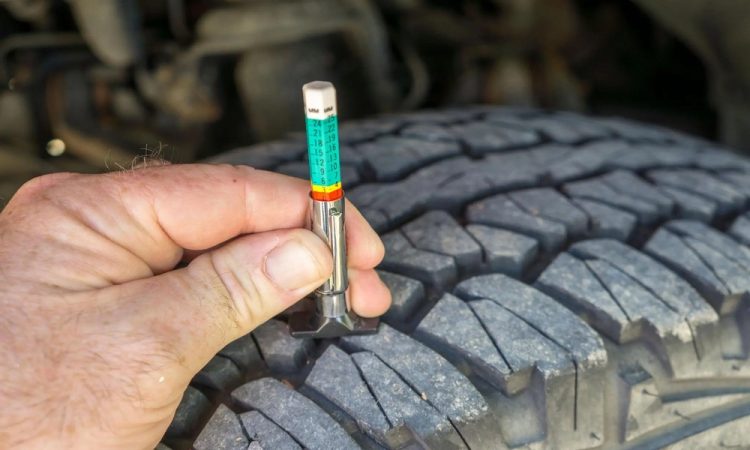
Federal regulations set minimum tread depth requirements for commercial vehicles: 4/32 of an inch on steer axles and 2/32 of an inch on all other positions. However, experienced fleet managers and tire professionals almost universally recommend removing tires well before those legal minimums are reached.
Wear patterns tell a story about more than just tire age:
- Center wear – consistent with chronic overinflation; the center of the tread wears faster than the edges
- Edge wear – consistent with chronic underinflation or overloading; both edges wear while the center remains relatively intact
- One-sided wear – indicates alignment problems on steer axles; the tire is running at an angle rather than straight
- Cupping or scalloping – diagonal or patchy wear patterns indicating suspension component wear, wheel imbalance, or alignment issues
- Heel-toe wear on drive tires – a normal wear mode on lugged drive tires, but accelerated heel-toe wear suggests inflation or alignment corrections are needed
Catching and diagnosing wear patterns early is far cheaper than running tires to failure. A tire that is wearing unevenly due to an alignment problem will destroy a replacement tire just as quickly if the root cause is not addressed.
Retreading: The Economics of Casing Management
Retreading is standard practice in commercial trucking, and it is one of the most misunderstood topics in fleet tire management. A quality retread performed on a sound casing is not a compromise – it is a cost-effective way to extend the value of the original tire investment.
The economics are straightforward: a new commercial drive tire costs $400-$600. A quality retread on the same casing costs $150-$250, and it delivers comparable mileage when applied to a casing in good condition. Over the life of a fleet, retreading can reduce tire costs by 30-50% per position.
Key considerations for a retreading program:
- Casing integrity is everything – a tire with sidewall damage, belt separation, or puncture repairs in the shoulder is not a retread candidate
- Use a reputable retreader – look for operations that use shearography or ultrasonic inspection to identify hidden casing damage before retreading
- Track casings by DOT serial number – the best fleets manage casings as assets, tracking each casing’s history through its full service life
- Position retreads correctly – retreaded tires are most commonly used on drive and trailer axles; steer axle retreads require careful quality control and manufacturer compliance with FMCSA rules
Integrating Tire Maintenance Into Your Broader Fleet Program
Tire maintenance does not exist in isolation. Alignment, suspension condition, brake balance, load management, and driver behavior all directly affect how long a set of tires lasts. An effective fleet tire program is built into the broader preventive maintenance schedule, not treated as a separate afterthought.
For fleets building out a comprehensive PM program that covers tires alongside engine, brake, and drivetrain service, the heavy-duty truck preventive maintenance guide from Heavy Duty Journal provides a structured framework covering service intervals across all major systems – useful context for understanding where tire inspections fit within a full maintenance calendar.
Practical integration points include:
- Alignment checks every 50,000-75,000 miles, or any time a steer tire shows one-sided wear
- Rotation programs on drive and trailer positions where appropriate – many fleets run a defined rotation pattern to equalize wear across tires on the same axle set
- Inflation checks as a mandatory component of every pre-trip inspection, not a once-a-week habit
- Documenting tire condition, pressure, and tread depth at each service interval to build a wear history that supports better purchasing decisions
The Cost of Getting It Wrong
A commercial tire blowout on a fully loaded Class 8 truck traveling at highway speed is not just a maintenance event – it is a safety incident with real consequences. Flying tread damages other vehicles, blowouts cause loss of vehicle control, and the cascading damage to wheel ends, brakes, and bodywork from a tire failure can easily run $5,000-$15,000 in secondary repairs, before factoring in towing, downtime, and cargo claims.
Fleet operators who treat tires as a cost to minimize rather than an asset to manage consistently pay more in the long run. The discipline required to maintain correct inflation, catch wear patterns early, and rotate tires on schedule is the same discipline that drives down total cost of ownership across every other vehicle system. The diesel engine maintenance schedule principles that apply to engine service – interval discipline, documentation, and proactive replacement – apply equally to tire management.
Final Thoughts
Commercial truck tires represent one of the largest variable costs in fleet operations, and they are also one of the most controllable. The difference between a fleet with a structured tire program and one without it is not subtle – it shows up in tire cost per mile, in blowout frequency, in fuel economy, and in the ability to predict replacement cycles rather than react to failures.
For fleet managers and owner-operators, the fundamentals are straightforward: select the right tire for each axle position, maintain correct inflation, inspect regularly, respond to wear patterns before they become failures, and integrate tire management into a comprehensive PM schedule. Those habits, applied consistently, are where the savings come from.
About the Author: This article was contributed by the editorial team at Heavy Duty Journal, a free digital trade publication delivering expert diesel maintenance, fleet management, and commercial trucking knowledge to technicians and owner-operators across North America.

